Merging six agencies without losing all six.
 Watch the session
The setup
Almost everything written about agency M&A is written from one of two chairs: the buyer's or the banker's. Multiples, earnouts, retention packages, the letter of intent, the diligence checklist. All of it ends at the signature.
The signature is where the actual problem starts. Six agencies with six leaders, six sets of creative standards, six definitions of what a good week looks like, and Monday morning arriving whether anyone is ready or not.
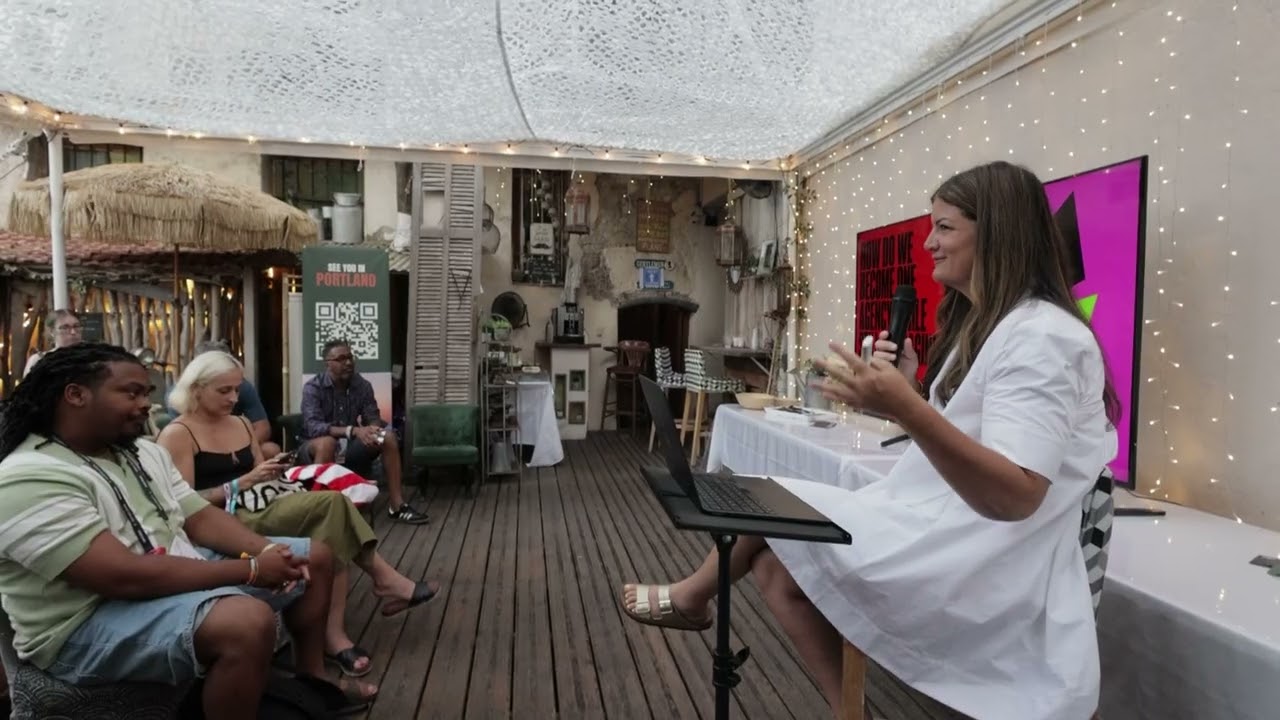
Heidi Singleton ran that Monday morning. Her talk was not about how to do a deal. It was about what happens in the 18 months afterward, when the org chart is settled and nobody knows what to call themselves.
"Usually mergers and acquisitions tend to start with the operational side of things, right? What are the systems? What's that org chart going to be? Who's staying? Who's going? Who's going to be in positions of leadership? All of those sort of organizational and operational decisions tend to get made first, and the reality is that's actually the easy part. The hard part is identity."
That is the entire premise, stated in the first 90 seconds. The systems work is bounded. It has a checklist and an end date. Identity has neither, and it is the part that determines whether the people you paid for stay.
Who was on stage, and why she's worth listening to
Part One — Why they started with belief instead of systems
The holding structure Singleton joined was a legal container, not a corporate one. Six agencies, each with a founder-operator who knew a category cold. One was a food and restaurant shop. One worked in health, wellness and education. Reunion was business consulting. TogetherWith was the Buenos Aires agency.
Every one of them was a real brand with a real position. That is what made the problem hard rather than easy. And the symptom showed up in the most ordinary place possible.
"People would ask me, 'Oh, what agency are you at?' And I didn't know how to answer that question."
Singleton was one of the first hires meant to work across all six, so she hit the identity gap before anyone else did. Her diagnosis was that you cannot ask people to be proud of a structural mechanism. The question she put to leadership was the one worth stealing: how do we become one agency while still leveraging the power of our differences?
Most integrations answer that question with a systems migration. Same templates, same process, same tools, same Monday meeting. Singleton's argument is that this buys you the wrong thing.
"Our goal was not compliance. When you start with systems, you get compliance. But when you start with shared belief, you have a chance at culture."
So they wrote the beliefs first. That the future belongs to brands that dare to be human, brands with character, conviction and authenticity. That human imagination and machine intelligence are both essential, but humanity is the competitive advantage. That the strongest brands move from transactions to trust, from campaigns to conversations, and from targeting to true connection.
Then they did the part that turned a values deck into a working idea. Because the group was born in Toronto, Louisville, Buenos Aires and Miami, Singleton framed the contrast between those places as the asset rather than the friction: data with empathy, logic with intuition, technology with humanity. She called the combination creative alchemy, and defined it as joining the things that do not normally belong together.
The naming decision followed the same logic, and it is the most transferable move in the talk. They did not commission a new name. They looked for the one that was already true.
"It's really about trying to identify what was already true about all of these agencies. I witnessed extremely collaborative people, extremely curious people from leadership all throughout the organization. I wanted to hold a mirror up to that with this new identity. I didn't want to force people into something that wasn't already authentic to who they are."
They took TogetherWith, the name of the Buenos Aires shop, and made it the name of the whole. The reason was not sentiment about the smallest office. It was that the phrase read as an invitation and a way of working rather than a label.
"Names are not just cosmetic; they can be a container for culture."
For any principal about to rebrand after a deal, that is a cheaper and better brief than the one most groups write.
Part Two — What got standardized, and what did not
Singleton's operating question is the one that separates this talk from a values exercise. Once the belief existed, she asked what should be consistent everywhere and what should stay local. Her word for the risk on the standardizing side is conformity.
"A lot of times when agencies merge, they tend to standardize everything. They want the sameness, but that creates the compliance, not the culture. People may follow the same processes and use the same templates and sit in the same meetings, but it doesn't mean that they believe in the same [thing]."
Four things got standardized.
The standard of the work. Every office had a different bar. Rather than force one aesthetic, they built a shared scale for ambition, which Singleton calls the humanity scale. Her framing of it is worth noting: she was explicit that this was not built as an evaluation tool. It was built as a shared language, including with clients, so that a conversation about where a brand sits and where it should go uses the same words in Toronto and Buenos Aires.
Who gets celebrated. Singleton's position is that recognition is the honest statement of a culture, and the wall poster is not.
"The heroes of the organization really tell you what your values are and what your culture is. It's not the words that you put up on the wall, and it's not the words in an onboarding deck, but it's really who you call out and recognize."
They built the Alchemy Awards around the behaviors they wanted repeated.
How work moves across offices. The test she uses is a language test, and it is easy to run on your own group tomorrow.
"You don't prove culture when people collaborate because leadership tells you to. Culture is when collaboration just feels natural. Instead of saying, 'Oh, we have a Toronto office,' it's, 'Oh, I know so-and-so in Toronto who can help, and he'd be great on this team.'"
If your people identify with a location before they identify with the agency, the integration has not happened yet regardless of what the letterhead says.
What people protect. This is the sharpest of the four, because it is the one that only reveals itself when business is bad.
"Culture really reveals itself under pressure. It's one thing when business is easy, things are going well. That makes culture pretty easy. But when business is hard, if there are things that people refuse to compromise on, that's when culture really starts to show up."
What TogetherWith found people protecting was a pair: brave relationships and bold work. Singleton's point is that the two are load-bearing for each other. Bold work requires trust in both directions, between account and creative internally and between agency and client externally. Which produced the single best line of the talk, and the one to carry out of this chapter:
"The strongest sign of a unified culture really isn't that people work the same way, but it's that they trust each other not to."
Four things did not get standardized.
Language. Roughly half of the company's approximately 120 people speak Spanish and half speak English. At all-agency town halls, CEO Brandi delivers her remarks in both. She does not speak Spanish. Singleton's read on why that works is precise: it is effective because it is uncomfortable to watch and harder to do.
"It is extremely vulnerable for her to do that. But it sends such a clear message to everybody that we value every language, and it just helps people feel seen and valued."
Location. Coming from a network with mandated in-office days, Singleton made the opposite call. People sit in Toronto, New Jersey, St. Louis, Louisville, Miami, Buenos Aires and Vancouver, and she is candid that this made the job harder rather than easier.
"We clearly decided that best-in-class talent is what we needed most at this time. That mattered more than proximity, but it also made things a lot harder. You have to be a lot more intentional about culture when everybody is not in the same place at the same time."
The intentionality shows up as ritual, which is the other half of her opening thesis. Creative teams across offices meet monthly to review work and share inspiration. There are monthly all-agency town halls and quarterly events. There is an exchange program that sends people from North America to South America for a couple of weeks and back the other way.
How people work. The most useful diagnostic in the talk came from outside the industry. Singleton introduced the Lewis model, built by British linguist Richard Lewis, which sorts communication and decision-making styles into linear-active (progress through structure), multi-active (progress through relationships) and reactive (progress through thoughtful collaboration and harmony). She used it because offices were reading each other's behavior as bad faith.
"There would be this tension between an office that was driven by results and deadlines, and an office that was more relationship-based, a little bit more laid-back. The friction often comes from style, but it's not competence and it's not intent. When we understood those different styles, we stopped judging those differences and started adapting to them instead."
How people play. Clear guardrails around client security and AI ethics, then latitude inside them. One of her creative directors, who also heads creative technology, built an AI fighter game on his own time as a way for creatives across offices to meet each other, with scenes based on company values. The same capability was pointed at an enterprise sales tool for a client. Singleton's framing:
"Culture needs guardrails, but it needs room to breathe as well."
Her own name for that balance is one standard, many expressions — a single bar for ambition and behavior, with local latitude on how it gets expressed.
The uncomfortable truth
The hardest thing Singleton says about the merger is not about the other agencies. It is about the sentence every principal uses to reassure their people during a deal, and she takes it apart.
"Culture is not what you keep; it's what you are willing to change. Everybody talks about preserving culture when you merge, but nobody wants to talk about what gets surrendered. We can't create one culture by protecting everything that existed before. We had to create it by agreeing on what mattered most and then letting go of the rest."
Sit with what that means operationally. Six founder-operators, each of whom built a distinct shop with distinct standards and distinct rituals, and the integration only worked because most of those rituals did not survive. "Nothing changes" is the most common promise made in agency M&A and the one most often broken by accident. Singleton's position is that it should be broken on purpose, out loud, with the list of what is being surrendered stated rather than discovered.
She pairs it with a second reframe that makes the first one survivable.
"Alignment is more important than agreement. We spent less time trying to get everybody to think the same way, and more time trying to get everybody to move in the same direction. The goal was not consensus; it was commitment."
And a third, which quietly indicts most integration plans, including the well-funded ones.
"Shared values do not create culture; shared experiences do. You don't build culture through decks and through murals on the wall or posters or launch meetings. You build it by solving problems together. Our culture really accelerated when our offices started working together, creating together, winning together. Nothing bonds you better than a gnarly new business pitch."
The uncomfortable part is the cost accounting. If your integration budget went to a brand launch and an offsite and no shared client work, you bought the artifacts and skipped the mechanism.
What you can use
Every session from Indies @ Cannes 2026 — plus every other Blueprint, the tools, and the surveys — opens up with one sign-in.