Closing thoughts, and a charge from the floor.
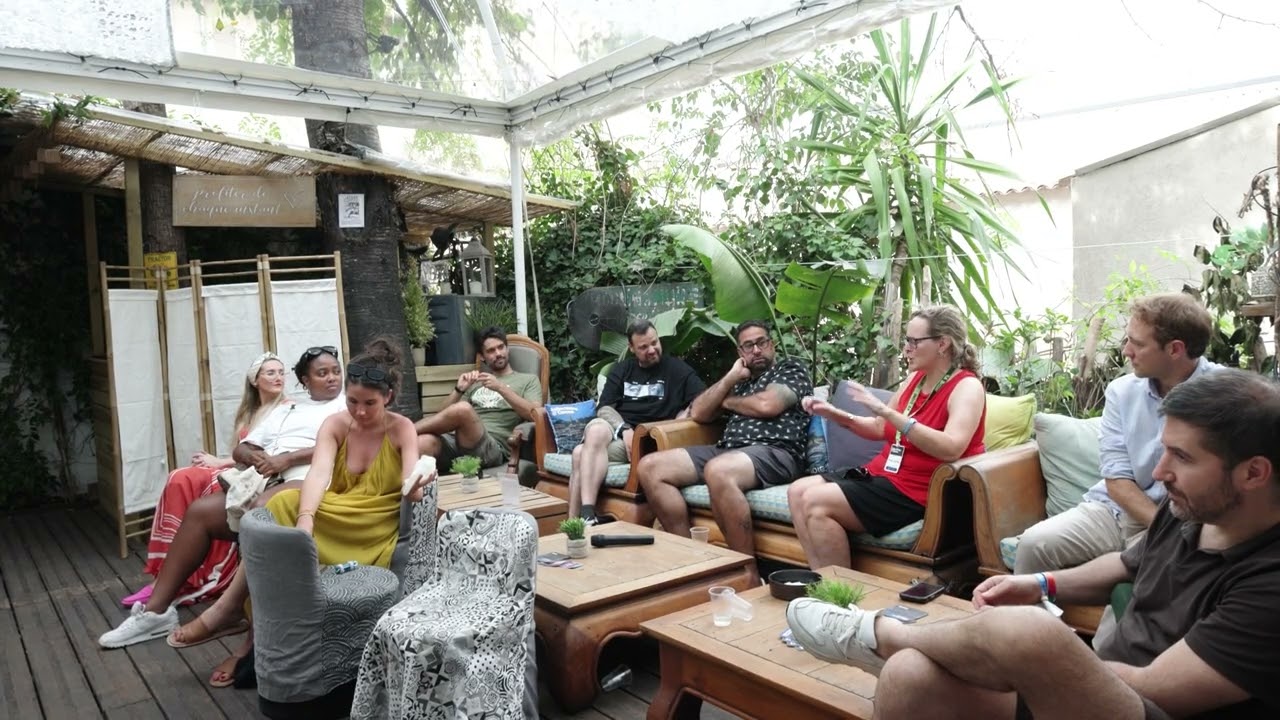 Watch the session
The setup
Every conference ends with somebody thanking everybody. The question worth asking is different: after three days of people describing how they run their shops, what argument has been made?
This session made one. It came from Doug Zanger, who runs Indie Agency News, the organization that programmed the week and publishes this Blueprint. He spent the first seven minutes on his own 14 years of coming to Cannes and arrived at a single claim about how independent agencies are treated by the brands that hire them. Then he opened the floor, and two people in the room told him the week had a hole in it.
That exchange is the reason this chapter exists. A closing session where the organizer talks for seven minutes and nobody pushes back is a colophon. This one produced a complaint, an unanswered question about where creative work goes when everyone is talking about AI, and two product announcements that a reader should weigh with full knowledge of who is selling what.
Disclosure, stated up front: Doug Zanger is the founder of Indie Agency News. Indie Agency News produces Indies @ Cannes and publishes this Blueprint. Two of the announcements below are IAN's own. They are reported here because they were said on the record in a session we are documenting, not because we are recommending them.
Who was speaking
Part One — The 14-year argument
Zanger's reflection could have stayed nostalgic. It did not, because it is organized around a single moment where somebody said the quiet thing out loud.
He set it up with a career arc. Copywriter in 1995. Advertising Week in 2010. The Drum. Adweek. He is direct about what the trade press can and cannot do, and he does not pretend the exit was about principle alone.
"It was genuinely an amazing experience to be at the trades, but that's not really where my heart was. The indie thing is very important to me because that's when I've been not only the most successful but the most fulfilled."
Then the moment. He was still at a trade publication, watching a session at the Palais where an independent agency and its client were on stage together. The word from the platform was partner, repeatedly. He went backstage afterwards to say it had been good.
"The CMO said, 'Oh yeah, no, they're just a vendor for us.' And it absolutely incensed me."
That is the argument in one sentence, and it is worth sitting with rather than moving past. The CMO was not being cruel. She was describing an accurate procurement relationship in the register brands use privately. The word partner had done its work on stage and was discarded the moment the audience was gone. Every principal reading this has a client who does the same thing, and most will never hear the backstage version.
"That was the galvanizing moment. I really want to fight for indies because I know how hard it is, and there's a real opportunity to create a genuine global home."
The origin story that follows is unglamorous by design. May 2023, a logo he calls awful, and a LinkedIn post used as a market test.
"I put up this awful logo in May of 2023, and that was my market research. I wanted to see if this was something that people would like. Then I said, 'Oh shit, I guess I got to build this thing.'"
Where the reflection earns its place in a Blueprint is the read on timing. Zanger's claim is that independent agencies are in the third major consolidation wave of his working life, and that this one ends differently.
"There have been several golden eras of independent agencies that have been acquired. This is probably the third time it's been a really big shift. There's going to be more durability for independent agencies going forward. That's why we all need each other. We all should compete, absolutely, but we all do need each other."
That is a forecast, not a fact, and it is being made by someone whose business depends on it being right. Hold it as such. The supporting observation underneath it is harder to argue with, because it is about how new business is decided:
"A marketer is going to look at work side by side and say, 'Yeah, that's good.' What's going to be different is your thinking. A marketer is going to look at the work and say, 'Yeah, to me that's the same, but this agency over here understands how to grow my business. This one's just really interested in doing fancy work.'"
If parity of craft is the baseline, and it increasingly is, then the differentiator is the argument you make about the client's business. That is a specific, testable claim about where independent shops win, and it points at exactly what the floor was about to say was missing from the week.
He also declined to pretend the festival is the point.
"In fairness to Cannes, Cannes has been very good to us. This isn't a diss on Cannes at all, but that doesn't interest me. It's the smaller rooms where you can speak to each other and really have deep conversations. This is where it gets done. Down there, that's for show."
Part Two — What the floor said back
Zanger opened it up with a question that could have gone nowhere: does anything stand out about the week? The first answer was a complaint.
A speaker from the floor said the festival had spent three days not discussing the thing it exists to celebrate.
"There's one thing that a lot of people have been talking about, which is that no one's talking about the work. Everyone's talked about AI so much. No one's really talking about the work, and I think that's really concerning."
Then the turn that makes it useful rather than a gripe. The speaker's point was not that AI talk is bad. It was that AI talk without a stated position is worthless, and that most shops have not done the work of forming one.
"We're in the most shallow industry on the planet, but now is the time to be a little deeper about what our industry really means and say, what does AI mean to us as humanity? Where does creativity end and where does AI stop? If you're not having that as an agency, you don't have a position, and you can't go to your clients and say, 'This is our perspective, and this is how we would handle your brand.'"
That is a diagnostic you can run this week. If a client asked your agency's position on AI tomorrow, would the answer be a paragraph you have already written, or would somebody improvise? The speaker's contention is that most independent shops are improvising, and that clients can hear it.
Zanger's response was to accept the finding and point at his own event formats as the fix, which is a product answer to a cultural question. More on that below.
The second floor contribution came from Katie Walley-Wiegert, who programmed the three days, and it identified a gap in how the industry talks about work at all.
"We talk about like the worst work ever, and we talk about the most immaculate, well thought. And there's really no space for the in between."
The in-between is the register where an agency says: here is what we set out to do, here is where the brand pushed back, here is the fight we lost. Her argument is that nowhere in the trade ecosystem is built for it.
"This is where we hit a battle with a brand, and this is where we couldn't actually fight the good fight and win, and be able to have a peer to say, 'I've actually been through this and here's how I'm having these conversations.' To really get into the work behind the work, and to bring vulnerability."
She named who cannot host that conversation, and Zanger sharpened it.
"An Ad Age or an Adweek or a Cannes, journalistically, can't actually do that."
"They wouldn't do it anyway."
Both are correct for different reasons. Trade press cannot run the in-between because a public account of an agency losing an argument to its client is a story about the client, and the client has a communications team. That structural fact is why the conversation has to happen in rooms like this one or not at all.
Walley-Wiegert's last point is the one to steal, because it is a test you can apply to your own internal sessions.
"I actually know what change I need to implement. I actually have something to take back home. Versus, I've heard and saw a lot, and I have no idea what to do."
Zanger answered with the metric he says the organization runs on internally.
"You know what our main KPI is internally? Confidence. If we do one thing that makes you more confident in your thinking and the way that you approach something, then we're doing our job."
Soft metrics are easy to hide behind, and confidence is about as soft as they come. It is worth noting the person who named it is the same person who then announced three products in the same breath. But the underlying discipline transfers: pick the one outcome you would defend if a client asked what they got, and design backwards from it.
The uncomfortable truth
A speaker from the floor told this room that the festival had spent three days talking about AI instead of the work. Nobody disagreed. It was the strongest note struck in the session.
What happened next, in order: Zanger acknowledged the complaint and pointed to IAN's Show Off events and Blueprint sessions as the answer. Then three products were announced. Here they are without adjectives.
Indie HQ. Indie Agency News is rebranding to Indie HQ, with the news operation continuing under that umbrella. Zanger put the timeline at "within a month" from June 24. The stated reason is architectural rather than cosmetic: the current site is WordPress, and services are buried under it.
"That's all I knew from the trades. You do a WordPress site, and then you make 1000 pages, and then it takes eight minutes for your site to load. We've made you jump through too many hoops to try to get to us."
Indie Agency TV (IAN TV). Described as, in Zanger's words, "basically curated YouTube," alongside a new community platform. The members' area is to include a support dialog box: "What can we do to help you today?" A submission triggers an alert on IAN's side.
These are IAN's own products, announced by IAN's founder, at IAN's own event, and reported in IAN's own Blueprint. Read them accordingly. Zanger's own framing of the odds is the fairest thing to quote here:
"We're absolutely trying things. Some of it's going to be amazing. Some of it's going to tank, and some of it is everywhere in between."
Rise's AI creative layer. Flavio Vidigal of Rise New York & Partners announced a product with the detail limited by what is still proprietary. His premise is a claim about what the tools are doing to the people using them.
"If social media took our attention out of us, out of our kids, AI fundamentally is making us more dumber."
His split is between two ways of using the same technology, and the product exists to force the second one.
"There's the lazy way to use AI, which leads to mediocrity and dumbness. And the other one is the dangerous way. They push your work, push yourselves to become better professionals."
The product itself:
"The product is basically a personality layer that will turn your AI stack into a creative asshole. Someone who pushes you and critiques your prompts and pushes you to prompt better."
The mechanic reverses the usual direction of the interaction:
"You prompt the machine, the machine will prompt you, and then you have to think more, think through, set clear visions in order to get something out of it. It's going to say, 'Hey, nice that you want three ideas for this briefing. What's your thinking? How do you think about it?'"
Roll-out as stated: internal pre-beta at Rise first, then partner clients and their in-house teams, then general availability. Sign-up was via a QR code and a form in the room.
Rise also described The Other Jury, an AI-simulated awards jury it launched the previous year as what the presenter called an experiment. The first version was fed roughly 20 years of jury-room transcripts and scripts, and generates a simulated debate between composite jurors until it reaches a verdict.
"We actually fed 20 years of discussions in the room. The AI was pretty trained with real materials. We generated a conversation in a room with real characters that almost averaged from all those years and understood how different personalities work inside the room. It would simulate like 100 pages of this debate until finding a result."
The first run picked a beer campaign over a cause-led entry, and the reasoning is the interesting part. The machine read one as brand-building work with commercial intent and the other as, in the presenter's account, "clearly built for awards, because it was breast cancer or something." He was careful to add that this was not a judgment on the cause.
This year the product is being reframed as "a second opinion for creativity," organized around one question: did the best work win? The stated plan is an agent that compares entries and sends people a shareable card when the AI's verdict differs from the jury's, timed to the LinkedIn wave after results are announced.
That is the sequence, and it is the uncomfortable part. A rebrand, a video platform, a community platform, an AI product and an AI awards jury. The session that diagnosed too much AI talk and not enough work talk closed with roughly 15 unbroken minutes of platform and AI announcements, and zero minutes on anybody's campaign.
That is not hypocrisy. Everyone in that room has a business to run, and a closing session is a reasonable place to announce things. But the sequence is evidence for the complaint rather than a rebuttal to it. The pull toward talking about infrastructure instead of output is not a Cannes problem or a holding-company problem. It operates on independents, on the people programming events for independents, and on the publication writing this sentence.
The second uncomfortable item came from Rise, and it was volunteered rather than extracted. Having built a machine to second-guess awards juries, the presenter turned it on himself.
"I would get very upset if people did that to my Grand Prix, but I'm the first one who does that to my own work. I did win a lot of awards before, but if you really talk to me having a beer, I'll probably tell you, I don't know if I should have really won."
That is the honest position on awards, and almost nobody says it while holding the trophy. It also quietly undercuts the product: if experienced people already know which of their wins were soft, the value of an AI second opinion is not discovery. It is permission to say out loud what you already suspected.
What you can use
Every session from Indies @ Cannes 2026 — plus every other Blueprint, the tools, and the surveys — opens up with one sign-in.