40 CMOs, on condition of anonymity.
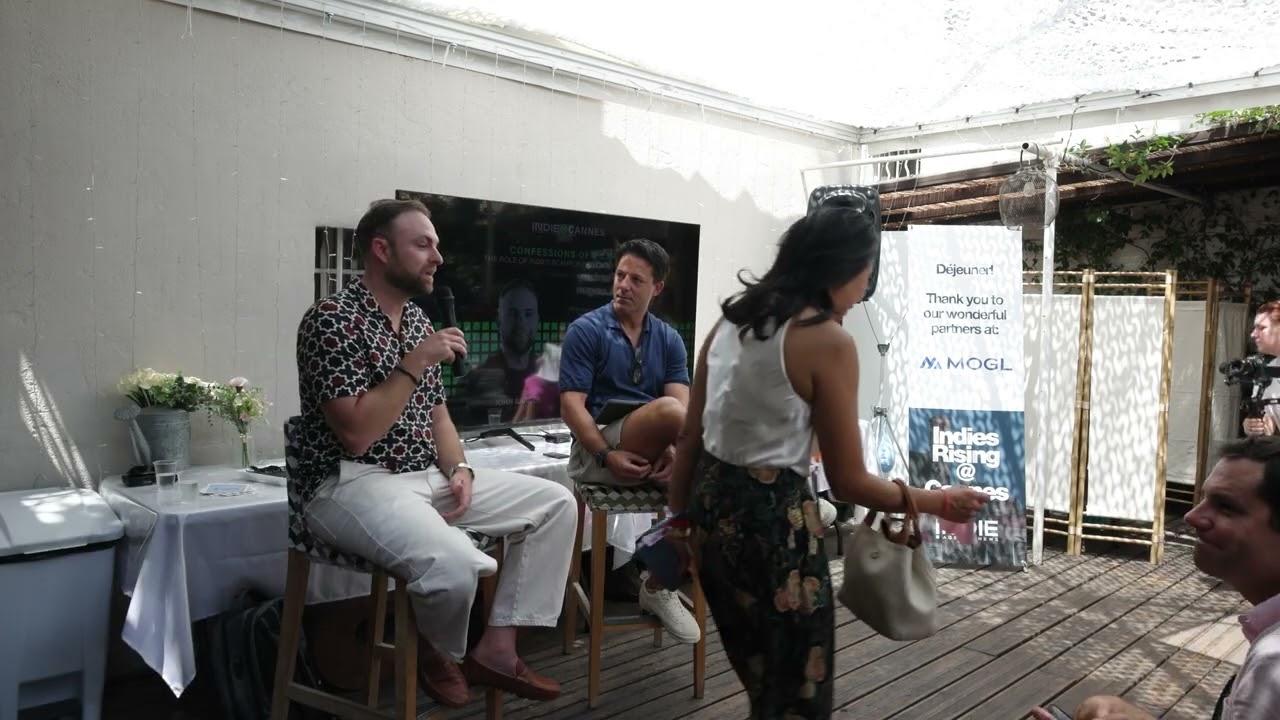 Watch the session
The setup
Every agency has lost a piece of work it should have won, or watched good creative die in a review, and explained it afterwards as a taste problem. It usually wasn't. It was a budget cycle, a sales leader with a louder voice, a CFO who had never been given a reason to believe, or a client who could not say out loud that they were losing an internal argument.
Agencies are good at diagnosing brands. Almost nobody diagnoses the building the brand lives in. Gabriel Cohen opened this session by asking the room to count how many clients would tell them the truth about that building.
"How many clients do we have who are able to be vulnerable with us and say, 'My CEO is a total douche'? Do you have any clients today who you can have some of those discussions with, or who come to you and say, 'I'm having this real challenge with this other stakeholder that's impacting my success in the job'?"
For most shops the honest number is one or two, and they are the accounts that never go into review. That gap is the subject of the session, and it is the reason Monigle went and asked.
This is the only session of the week built on original research. It is also the client's side of nearly every complaint agencies made across the other five days.
Who was on stage, and why they're worth listening to
Part One — What the fight inside the building looks like
Barger's first answer was a mistake, offered without prompting.
He had pitched acquisition targets. He knew how to talk to a CFO. He assumed that skill transferred, and that the existence of a brand role meant the value of brand was settled.
"The first mistake I had was coming in thinking, hey, they created this role and they understand the value of brand. And we were in the very early stages of that."
Then the CFO call happened.
"I'm having a call with a CFO, and he's like, 'All right, if I give you $5 million to invest in brand, what is that going to give me in the next six months, and what does that look like?' And I was like, 'Well, we're tracking it via this, this, this.' He's like, 'I don't understand that. I need to see the ROI, whether it's increase in sales, whether it's more efficiency.'"
Note what the CFO rejected. Not the number. The measurement framework. The agency had supplied a way of counting that the person holding the money could not read, which meant the client had to defend it alone, in a language he did not yet speak.
What helped, in Barger's account, was case evidence from outside the usual sources.
"You have an agency who's done this so many times, and being able to bring case studies that are relevant. It wasn't the CPG case. It was, hey, here's a B2B case, here's a B2C."
He is candid about the limits of that. Case studies from your agency arrive pre-discounted.
"There is a little bit of faith involved, and skepticism internally. Like, of course an agency is going to share this with you because this is better for them. And being able to champion it internally is one of the hardest things."
Which is the first structural finding of the session. Whatever an agency hands a client has to survive a room the agency is not in, delivered by someone whose credibility is on the line, against people who assume the agency is talking its own book.
The masterbrand fight. ResMed moved from a house of brands to a masterbrand. Cohen described these moments as the ones that get gnarly, and Barger did not soften it.
"We were starting to have a conversation of, hey, now you're going to be part of this, and they're like, no, absolutely not. Like, who are you to tell me?"
The counter was research rather than argument: an unbiased listening study, direct quotes from customers, including customers those acquired-company leaders had personal sales relationships with. The customers said what customers usually say.
"Yeah, we don't care, as long as the quality and the product and everything are still being delivered on."
That settled the commercial objection and left the real one standing.
"What it didn't solve for is the CEO of that acquisition losing their baby. Like, this is my brand, this is the company name, this is why we have this. If you take this away, you're going to lose credibility in the market."
Data does not resolve grief about a name. Authority does. The thing that closed it was the ResMed CEO saying the decision out loud: this is what we're doing, and if you don't like it, you have to live with it.
The logo fight. The logo was not in the original scope. It came onto the table mid-engagement, on a company more than 35 years old, which is the point at which every executive becomes a creative director.
"The minute you change a logo, or you talk about changing a logo, everybody has an opinion, and they're all marketers."
His example of the objection is the one every strategist has heard.
"I don't think these colors work for us anymore, and we should be going with this other style, because I've got a buddy in CPG, and that's what they said is going to be resonating with the market."
18 months on, the same executives have arrived somewhere else.
"Now the conversations have shifted. It's, wow, initially I didn't really understand it, but now it makes sense, and it aligns with who we've always been."
That lag is the number worth carrying out of this section. The judgment executives make in the review is not the judgment they will make a year and a half later, and the person who has to survive the intervening period is your client, not you.
The timeline fight, and the single most transferable move in the hour. Every budget cycle brought the same question: have we seen the ROI yet.
"Companies go through a brand transformation in the course of several years, and we're trying to do it in eight months to meet this financial calendar."
His response was to stop carrying the argument by himself.
"Being able to work with the agency as well to say, 'Hey, I want you to come in as we have this conversation with the CEO and with the board, to say that doing this quickly is not the best approach.'"
The agency was used as external authority, in the room, on a question of pace. That is a different job from the one on the scope of work, and it is the job the client most needs done.
Part Two — What the work becomes when it lands
Coming out of the rebrand, Barger wanted to change how a healthcare company tells stories. Creators. Sports sponsorship. Neither had been done at ResMed. Cohen was direct that this one lacked the cover the rebrand had: the CEO did not necessarily have his back, and nobody else in the organization was pushing for it.
Barger's phrase for the shift became the room's shorthand.
"What I like to say is taking the clinical to the cultural, and being able to appeal to people in ways that they're already engaging with content."
The sports logic was commercial rather than glamorous.
"Sport is one of the last things that people will sit and watch ads through."
And the proof point inside the storytelling was a single fact, which is how a clinical category gets cultural.
"This Olympic runner would rather sleep an extra hour than train an extra hour."
What made the agency relationship work on that campaign, in his telling, was posture. The agency did not lead with expertise.
"The agency approached it not from the sense of, like, we know more than you, but hey, these are things that are happening in the industry overall, and if we don't drive a bold change in how you market, then you'll just be left to the side."
He named the alternative himself: a sea of sameness, and "the risk of being boring, as people say, is too high."
Then the results arrived, and the results are where most campaigns lose their internal argument. ResMed's largest consumer campaign to date, built on an insight about sleep affecting relationships rather than the sleeper, narrowed to fewer markets because a sales leader wanted a clean read on impact.
"It's like, hey, we had half a billion impressions, and they're like, cool. Where's the sales?"
The therapy timeline runs months, so the sales data was not there when the question was asked. Double-digit growth in those markets landed later. And even that did not close it.
"The hardest part is saying, hey, this is driven by marketing, and they're like, well, actually, our sales team also had a lot of conversations about that."
The campaign won a Silver Effie. It still had to win the internal attribution argument twice.
The uncomfortable truth
The sharpest passage of the session is Barger describing what his own colleagues do to agencies, and he does not present it as a rare failure.
"Unfortunately, what happens too often that I see internally is it's so easy to blame the agency. There's a scapegoat. It's, hey, the campaign didn't perform, probably because the creative sucked, or the media buy was wrong, or the strategy was what we didn't agree with but they said it because they're the expert. I think it's a cop out."
That is a client-side executive confirming, on stage, the thing agencies say privately and cannot prove. It came with the countercharge attached.
"An agency can only be as good as the partner and the people who help them."
His defense against it was procedural rather than emotional. He ran weekly conversations with the account team, not with his CMO, before the senior meetings happened.
"Hey guys, this is what we're dealing with. When you have this conversation with the CMO and with our senior leaders, you need to know that going into it. You have to avoid these landmines."
The room pushed back on whether that street runs both ways. A voice from the Indie Agency News side of the room raised the asymmetry directly: a CMO who took two to three weeks to respond on something important, blew up their own budget, and let the agency take the heat. The same contribution framed the arithmetic that the rest of the hour kept circling. A generous 10% of the CMO's existence is 100% of the agency's. Cohen, crediting John Evans, had put the same math the other way around earlier in the session: the work an agency does is roughly 5% of a CMO's professional life, and the other 95% is where almost nobody shows up.
An agency leader in the room named the version of this that costs the most work. Their CMO and their CEO were not speaking to each other, and the agency was left to work out on its own which internal fight it was allowed to enter.
"It's mom and dad, and mom and dad don't talk, and we make assumptions of what battles can be picked and why."
Assumptions is the operative word. Nobody briefs an agency on which arguments are live upstairs, so the account team makes the call on incomplete information and finds out it guessed wrong when the work dies.
Barger's answer to shared accountability was a push-pull he could describe in both directions. If creative underperforms, the agency comes in and says why. If the media plan looks wrong, the client says so. On the campaign in question, that mechanism killed a heavy podcast and audio spend that was delivering reach without conversion.
"Just like we would hold our internal teams accountable for the performance, we would hold the agencies accountable."
Here is the uncomfortable part for independents. Being treated as an extension of the team is what almost every agency says it wants. It comes with the accountability attached. The relationship Barger describes as healthy is one where he can tell you your creative is failing and you can tell him his media buy is wrong, in the same week, without either party going quiet. Most agency-client relationships are configured to prevent exactly that conversation.
What you can use
Every session from Indies @ Cannes 2026 — plus every other Blueprint, the tools, and the surveys — opens up with one sign-in.