AI, craft, and who the time savings go to.
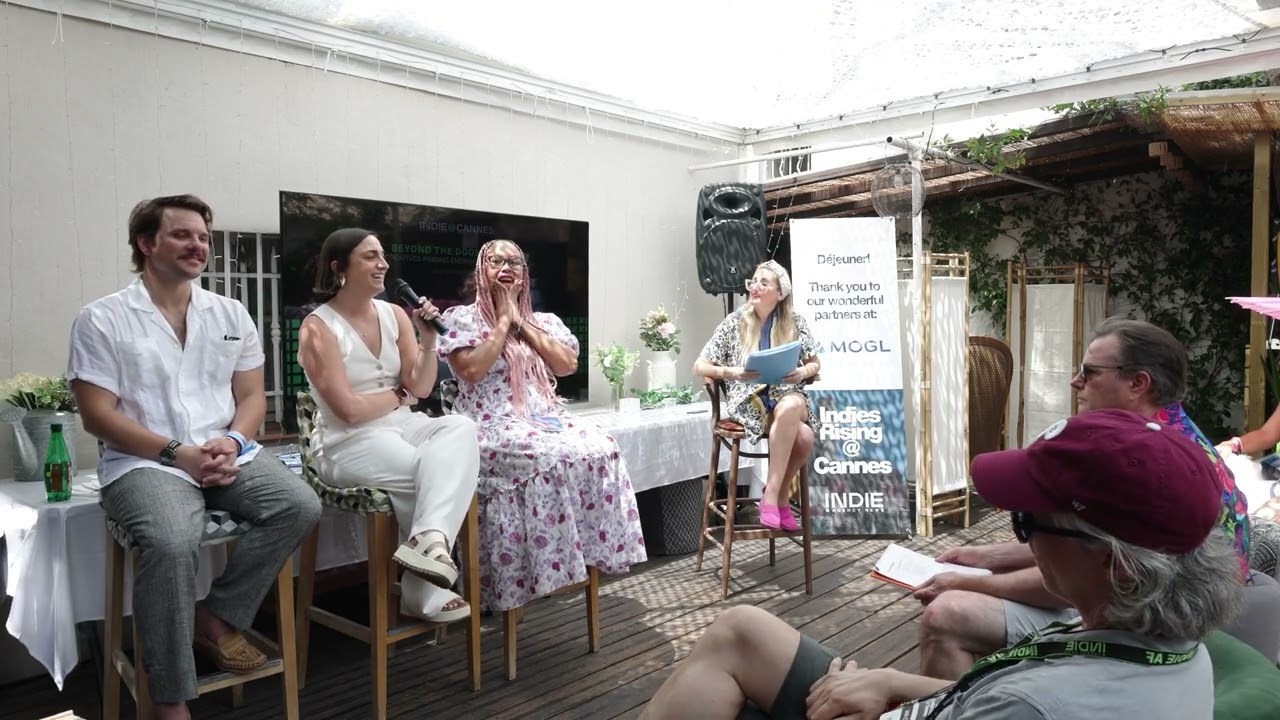 Watch the session
The setup
Most AI conversations in this industry arrive in one of two shapes. There is the sales pitch, where every example works and nobody mentions what got cut. And there is the wake, where the tools are a symptom of decline and the only honest posture is refusal. Neither is useful to somebody who has to decide on Monday whether a junior art director should be prompting or sketching.
Katie Walley-Wiegert opened by naming the gap and refusing both shapes.
"It's one thing to be positive about AI, but as many people in this industry experience it, it sometimes can feel like forced adoption and toxic positivity more than real utility."
That is the problem the session was built to answer. Not whether AI works, but whether the enthusiasm around it is being manufactured somewhere above your head and pushed down as a mandate. Three practitioners spent the hour describing what they have changed in the making of the work, what they have refused to change, and where the money model breaks.
The panel disagreed on one significant point, and the disagreement is the most valuable thing in the transcript.
Who was on stage, and why they're worth listening to
Part One — The slop problem, and who it belongs to
Katie put three tensions to the group in sequence. The first: generative AI will drag everything to the lowest common denominator.
Josh went first on the framing question, and started by pricing the holding-company version of this conversation.
"Holding cos have made massive investments in AI. You know, billions and billions of dollars. The next largest investment they make is in us and people. Those AI investments haven't paid off just yet."
His point was structural. When a company has spent billions and has quarterly shareholders, the internal narrative about AI has a job to do that has nothing to do with the work. Independents do not carry that obligation.
"We only invested in AI where it made sense to make investments in AI. So today, our conversation will be grounded in truth because we don't have any shareholders."
That is the argument for why an indie can have this conversation without an investor story to protect. It is also the standard the rest of the hour had to meet.
Chelsea's answer to the slop question inverted the premise. Katie asked whether clients and talent were becoming desensitized to human craft. Chelsea has seen the opposite: an audience on a hair trigger.
"I've also seen things that are beautifully made with CG that are like, that's AI. I've seen things that are very clearly real videos shot with an iPhone, like, that's AI. It's almost like our brains have been wired to be ready for it and on edge."
The commercial consequence lands inside client presentations. Early-stage AI comps read to a client as finished, which collapses the room's ability to imagine a better version.
"It's almost like we need to make it purposely worse so that way we can be like, trust us, it's gonna get better."
Her response was to change what gets presented. Concept alone no longer survives the meeting, because the client has already seen a rendering and formed a verdict.
"Now when we're sharing work, it's not just about talking about concept. It's already getting to the treatment and the execution."
Josh's counter-frame was the oldest one available and it holds up. New tools do not lower the ceiling on people who already have craft.
"If you were a great creative and you started using Photoshop, it didn't make you a worse creative. In my world, math, science, using Microsoft Excel — I know it's super lame — but it didn't make me worse at math. It made me a lot more efficient, a lot more effective."
Neisha reframed the slop question as a marketing failure by the category itself, which is the funniest and most damning line of the hour.
"AI as a whole may have needed to have hired an ad agency before it launched."
Then she did something the rest of the panel did not, and defended the audience for mediocre AI output. Her mother listens to audiobooks narrated by an obvious synthetic voice.
"This narrative sucks, mom. Like I know what's gonna happen next. But it's how she calms down. It's what she wants when she's cooking. So there's an audience for everything. And in advertising, we are very elitist, so we look down on things like that."
The conclusion she drew from that is the frame the rest of the session ran on.
"McDonald's is in business because people like fast food. AI slop is for somebody. People are going to like that. The question is, what kind of chefs do we want to be?"
The question is not whether the low end exists. It does, it is enormous, and it will be served. The question is what you are for.
Josh has an answer to that in the form of a side project. A creative brought him an AI-generated Lord of the Rings anime short on a quiet Friday, and he realized he had no idea where good generative video lived. That night he and the creative built a platform.
"It is the first and still only streaming platform exclusively for generative video. It is the most absurd, but engaging content that you can possibly imagine."
He calls it Slop Bucket. The name is the argument: the category is real, it has an audience, and pretending otherwise is a way of not looking at it.
Part Two — Where the work changed, and where it didn't
Katie's second tension was the one that gets whispered in creative departments rather than said out loud: using AI is cheating.
Neisha's answer went at the belief underneath the guilt, which is that suffering is a proxy for quality.
"You become a creative director because you are smarter, faster. So the AI is helping you be smarter, faster. It's not about the time or effort you spend on the thing. It's the quality of the thing at the end of the day."
She wrote a book with AI, three times over. The first pass was reconnaissance, learning how the machine constructs a story and where its instincts fail. The subsequent passes were hers.
"This is my book because I'm putting so much of my thought, my heart, my energy, the nuance of language, and the human experience that I understand."
Landing the point, she reached for a word and could not find it, and asked the panel for the math term for two things moving together. Josh supplied it: correlated. Her thesis, assembled with an assist:
"We need to get past this idea that effort and output are correlated."
Chelsea agreed with the principle and then contradicted the promise attached to it. The efficiency has not shown up as free time in her department.
"I actually have found that in many ways AI has caused our creative team to work longer and harder."
Her reason for that is worth the price of admission. The fear of AI as a shortcut assumes the shortcut is invisible. It is not.
"You can't cheat well with AI. Your cards are showing when you use AI."
And her working assessment of what the tools are good for, which is the most quotable diagnostic on the panel:
"It's a good jump start, it's a great researcher, but it's a really shitty conceptor."
Josh's contribution here was a warning about provenance, delivered as a joke that stops being funny about four seconds in. Early foundation models leaned heavily on scraped forum text.
"They started off with just the top comments on Reddit. That was the primary training data. Do any of y'all go on Reddit? Do you see the comments on there? So when you get crazy hallucinations from AI, that should be expected. It's the most unhinged part of the internet, just kind of mirrored back to you."
Neisha extended it into the clearest mental model anyone offered for why AI output tends toward the average, and it is a model you can draw on a whiteboard.
"If you imagine, based on the entirety of the human experience, that's an ocean of information. Then you think about that AI is built on what was digitized. Then we get to a lake. Then you think it was built on what people in particular thought was worth putting into the AI. Then we get to a well. So we're digging from such a small and specific well."
Which produces her posture toward the tools, and the line the room reacted to hardest.
"I actually operate as if it's my junior creative. You were 22, girl. I have been in this business for 20 years. I know what I'm doing. I'm happy to spar with you. I'm happy to ask questions and all of those things, but I don't trust you. You are the magic."
So what changes in the process? Chelsea's answer was precise, and it is the single most useful operational observation in the session. The stages did not disappear. They stopped being sequential.
"There's been a bit of a collapsing of concepting and execution. It starts to happen faster, but more so just concurrently. We have a concept, we see how that might come to life, then we try another concept, see how that might come to life."
The risk that creates is a training risk, and it lands on the people with the least protection.
"It's made my spidey senses go up for our more junior talent, impressing upon them the importance of concepting, how it is going to become the most important thing. You go back 20 years, younger talent always wanted to get to the execution first. Here's the thing, what do you think of this? And it's like, well, what's the idea?"
Her conclusion: "You got to start from concept and foundation."
Neisha teaches the same lesson through a stall. In a recent class, after the group had generated images and locked a visual world, she stopped them before video.
"I was like, let's brainstorm what this video is going to be. And they all paused, and they were like, oh wait, what? And I'm like, we're not just gonna make a video. We need an idea."
30 minutes of brainstorming produced dogs playing volleyball in 1980s Los Angeles, with a pit bull and some drama. The output matters less than what the pause taught.
"That was the unlock for them, where they were just like, oh wait, yeah, we need to have a good story, some drama, we need some tension, and then we can make the thing."
Josh, who builds the tooling, agrees with the creatives on where the tools fail.
"When they go to AI and say, give me an idea for a video to make — it's not great at that at all. But when you have a really good idea that you've refined, you've tested, you've collaborated with people, and then you use AI as a tool, it's great for bringing your vision to life faster."
Where AI has changed the work rather than accelerated it, on this panel, is research. Chelsea described the speed to a usable insight as the thing she is most excited about, with a caveat about the limits of standing in for someone else.
"One of the most challenging things about being a creative in advertising is you're rarely going to be the bullseye target audience. You have to put yourself in the shoes of the consumer that you're trying to reach."
And the effect on roles, which is the quiet structural story of the hour:
"AI is actually letting us become much more multi-hyphenate. We contain multitudes. I'm not just a creative. I am also a strategist. As a writer background, I'm now suddenly pretty well versed in Figma and pretty well versed in camera techniques and lighting techniques. Things that I didn't know, to be quite frank, 18 months ago."
LERMA's version of this is built rather than adopted. Josh described a tool his team made because prompting is a hostile interface for a visual thinker.
"It's not natural for a creative visionary or a director to imagine a scene and then just type it out. We built a tool that allows them to actually frame a shot. It's a 3D world, and they have a camera. They can define what type of camera it is. They can set the lighting. They can drag in characters, objects, props, scenes, whatever they want to do completely visually."
The staffing decision underneath it is the transferable part.
"We took people that knew how to code, who knew how to build platforms, and partnered them with the creative team to actually build something new."
The uncomfortable truth
The panel agreed on craft. It did not agree on what AI does to the working life of the people doing the craft, and neither side blinked.
Josh's case is that removing volume work from human hands is a moral improvement. He built a career on personalization at scale, and he watched what the production burden of that did to people.
"If you are someone that is able to come up with incredible ideas creatively, and then you get stuck making 1000 different versions of it, that was not, in my opinion, even humane. That is something that a machine should be doing."
His projected outcome:
"It can bring the costs down, and it can amplify creativity in a way that I think gets us to spend more time with our families, leave work earlier, go have hobbies."
Chelsea's report from a working creative department is that this has not happened. The tools raised the expected standard of a first look, moved execution earlier, and added iterations rather than removing them. Longer and harder, in her words.
Both accounts are credible, and they are describing different jobs. Volume production compresses. Craft expands to fill the space that compression opens. If your agency's product is versioning, AI is relief. If your product is the idea and its finish, AI is a new set of expectations arriving without a new set of hours.
Underneath the disagreement sits the commercial problem nobody on stage pretended to have solved. Josh named it in plain terms.
"Agencies, we inherently bill by the hour for a lot of the work that we do, and getting that done faster would mean that we would charge less money."
Then he put a number on it.
"I know that a year ago it took me 100 hours to do something that takes me two now, and that's something for us all to wrestle with."
And the conclusion, stated without a solution attached:
"We're going to see some change of the agency model. How we make money is going to change. I think that's pretty much inevitable at this point."
That is the uncomfortable part. Every principal reading this is running a pricing model that assumes the second number is closer to the first. The panel's answer to the client-does-it-themselves scenario was confident and, on the evidence, correct. Josh:
"Clients have never paid us for decent. They've never wanted to pay us for decent."
Neisha's version reframes what a client is buying when they hire you, and it is the sentence to put in a new-business deck.
"The thing that we want is not really a prompt. We want a brief."
She went further, and argued that a client discovering AI is a lead rather than a loss.
"Once a client realizes, oh, I can make this basic thing on my own with AI — I need a better agency. I need a smarter agency. I need a more strategic agency in order to do something bigger and more valuable and impactful for my business."
Both of those are true, and neither of them tells you what to put on a rate card when the work takes two hours instead of 100. The session left that open. Every session about AI leaves that open. It is the loose thread of the week.
There is a second uncomfortable finding, and it belongs to Neisha. The resistance in agencies is being read as cynicism. She says it is something else, and the misdiagnosis is why adoption programs fail.
"It's less of a cynicism being the issue, it's the lack of confidence."
Her evidence is a student, a former global marketing director at Amazon, who arrived at the first class saying she was petrified of AI and left the last one saying she knew what was her and what was the machine. The intervention was not training on tools. It was making her articulate what she was already good at.
"You know that yes, it knows a lot, but you know better."
What you can use
Every session from Indies @ Cannes 2026 — plus every other Blueprint, the tools, and the surveys — opens up with one sign-in.